Visitors to the Tower of London encounter stories of the fortress’s turbulent history told by Yeomen Warders. Though dramatized, these accounts contain historical truth — the Tower served as final residence for many nobles during the Tudor period, including Anne Boleyn, Catherine Howard, Lady Jane Grey, Thomas Cromwell, and Thomas More.
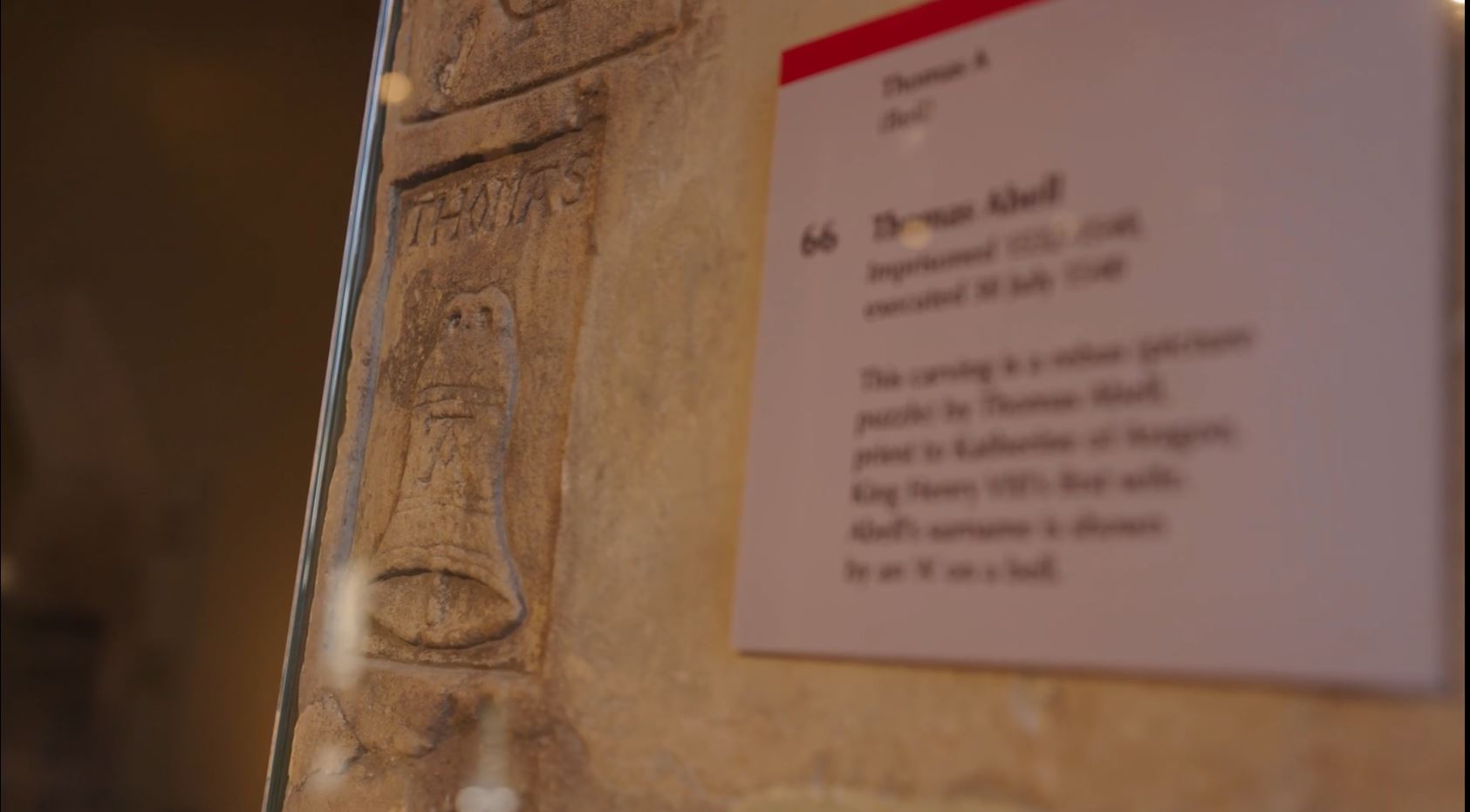
In the Beauchamp Tower’s upper chamber, prisoner graffiti covers the stone walls. Among the most prominent markings is a bell carved with the letter A in its center and “THOMAS” written above it — the work of Thomas Abell, who occupied that room alone for nearly seven years before his 1540 execution.
Abell was a Catholic priest serving as personal confessor to Katherine of Aragon, King Henry VIII’s first wife. Though never formally charged and tried, he was presumably arrested for publicly supporting Katherine’s right to remain queen. An act of attainder eventually led to his execution on treason charges.
In 1532, Abell published Invicta Veritas (The Unconquerable Truth), rebutting theological arguments that Henry’s marriage to Katherine violated divine law. Using identical biblical texts, he demonstrated the marriage’s biblical legitimacy. Henry attempted suppressing copies; two survive, including one at the British Library.
Abell likely entered the queen’s household around 1529 when Cardinal Wolsey appointed him Katherine’s chaplain, possibly expecting his loyalty to serve the king’s interests. However, Abell’s allegiances shifted, particularly during a covert Spanish mission to retrieve a papal brief supporting Henry and Katherine’s marriage from Emperor Charles V. Abell secretly advised Charles against returning the document to England.
By 1533, Abell’s second arrest reflected accusations that he publicly opposed the king’s divorce and encouraged Katherine’s staff to maintain her title as Queen. The bell symbol Abell carved into the Tower wall represented a family pun on the Abell surname, but it carried deeper meaning — bells summon people to worship, alert to danger, and remind of God’s presence. Through his carving, Abell preserved his identity despite forfeiting his life.